


How to Choose a Payment Gateway for CS-Cart by Market
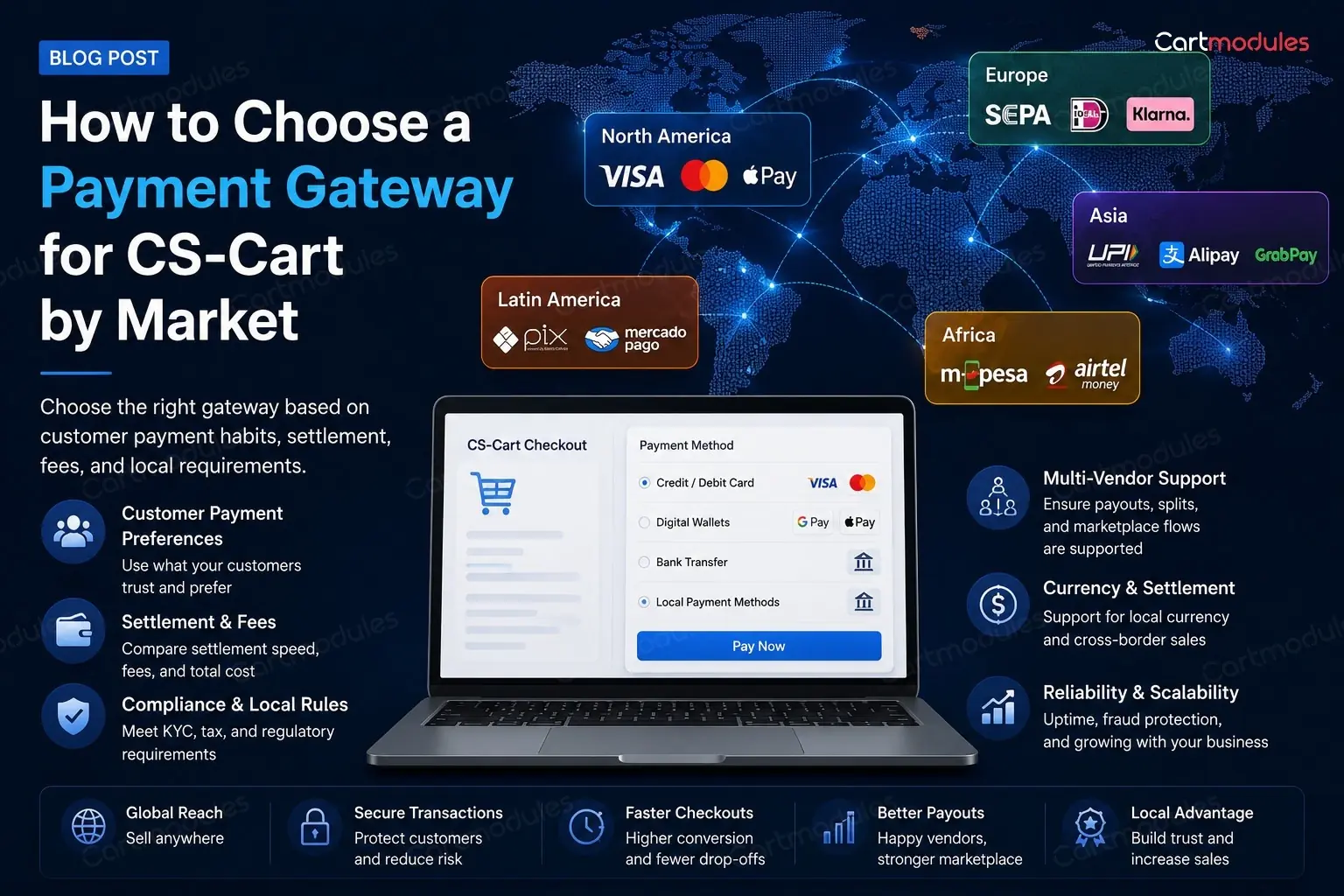
You're opening in a new market. You've got Stripe or PayPal working, and someone has told you that isn't enough. They're probably right. But the advice usually stops there.
This is a guide to what buyers in different markets expect to see at checkout, and how to think about the choice. We build payment gateway add-ons for CS-Cart across most of these markets, so we'll name our own where they fit. We'll also name plenty we don't sell, because pretending otherwise would make this useless to you.
Last reviewed August 2026. Gateway availability, merchant eligibility, fees and supported payment methods change often. Confirm current details with the provider before you build.
Start with the right question
Most people ask "which gateway is best?" That has no answer. The useful questions are:
What do buyers in this market actually use? Not what's available, but what people reach for. In the Netherlands that's iDEAL, and a checkout without it can lose sales to a competitor that offers it, no matter how good your card processing is.
Can it settle into an account you can actually hold? Plenty of gateways require a locally registered company and a local bank account. This kills more market launches than any technical issue, and it's worth checking on day one rather than day ninety.
What does it cost, all in? The headline percentage is the start. Then: fixed fee per transaction, currency conversion margin, chargeback fees, monthly minimums, settlement delay. A 2.4% gateway that settles in 14 days can be worse for cash flow than a 2.9% one that settles in 2.
Does it do what your store needs? Refunds and partial refunds through the API, not just their dashboard. Recurring billing if you sell subscriptions. And if you run a marketplace, split payments, which is where most gateways quietly fall over.
What CS-Cart gives you out of the box
CS-Cart ships with support for the big international processors and a set of common methods. For a store selling to the US, UK, Western Europe and Australia in one currency, that's often genuinely enough. If it covers you, stop reading and go do something more useful.
Where it runs out:
- Local methods that dominate a specific country
- Buy now, pay later
- Mobile money and wallet payments across Africa and parts of Asia
- Cash on delivery done properly, with the rules around it
- Split payments for marketplaces
- Regional processors that are the only realistic option in their market
The Gulf and Middle East
What buyers expect: cards, buy now pay later, and cash on delivery. BNPL adoption in the Gulf is high and still growing. A checkout without it looks dated to a Saudi or UAE shopper.
Cash on delivery still matters in some categories. If you sell to Saudi Arabia or the UAE and don't offer it, you're excluding a real share of buyers. It brings its own problems: refused deliveries, cash handling, reconciliation. So set a maximum order value and restrict it by region.
BNPL: Tabby and Tamara are the two that matter. We build and maintain add-ons for both. They're regional. Offering Afterpay to a Riyadh shopper isn't a substitute, because they've never heard of it.
Cards: local acquirers usually beat international ones on approval rates. Worth asking any provider what their approval rate looks like for your card mix, because a cheaper gateway that declines more cards is more expensive.
Also worth knowing: local schemes like mada in Saudi Arabia are widely held and often cheaper than international cards, so check whether your acquirer supports them.
India
The short version: one gateway rarely covers India properly.
UPI is the default. It's the way a large share of Indian buyers expect to pay online. If your checkout doesn't offer it, you're an inconvenient store.
Then netbanking, which matters far more than in most markets: dozens of banks, and customers expect to see their own.
Then cards, then wallets, then cash on delivery.
Practically: most stores use an aggregator that covers UPI, netbanking, cards and wallets behind one integration, rather than wiring each method separately. We build a Cashfree add-on for CS-Cart; Razorpay and PayU are the other names you'll hear, and either can be the right answer.
One thing to plan for: recurring payments in India are more restricted than elsewhere, with mandate rules that don't work the way subscription billing does in Europe or the US. If you sell subscriptions, check this before you build.
Bangladesh and South Asia
Mobile financial services lead. In Bangladesh, bKash is what people use. Treating it as a secondary option next to cards has the priority backwards.
We build add-ons for bKash and aamarpay for CS-Cart.
Cash on delivery remains large across the region. Build for it properly: order value caps, address confirmation, and a refused-delivery process.
Africa
Payment behaviour varies enormously by country. Don't treat Africa as one market.
Mobile money is the main story. M-Pesa in Kenya and Tanzania, MTN Mobile Money across several countries, and others region by region. For a large share of buyers this isn't an alternative to a bank account, it is the account.
Nigeria runs on bank transfer and cards, with USSD still widely used. Paystack and Flutterwave are the names to look at; neither has a CS-Cart add-on in our catalogue yet, so that's a build.
Settlement and currency are the real catch. Confirm you can get money out in the currency you want before committing to a market. If the gateway you need has no CS-Cart integration, talk to us about building one. It's most of what we do.
Europe
Cards work everywhere in Europe. They're also frequently not what people prefer.
| Country | What buyers expect |
|---|---|
| Netherlands | iDEAL. A payment method buyers expect |
| Germany | Bank transfer, direct debit, and buy-now-pay-later. Card penetration is lower than people assume |
| Poland | Przelewy24, BLIK |
| Spain | Bizum |
| France | Cards, plus instalments. Alma is well established. We build an Almapay add-on |
| Hungary | Barion. We build an add-on for it |
| Nordics | Klarna, Swish, MobilePay by country |
SCA and 3-D Secure apply. Strong Customer Authentication isn't optional in the EU and UK, so whatever you pick has to handle it properly, and handle it well, because a clumsy 3-D Secure step is a real source of abandoned checkouts.
Also worth knowing: we build Buckaroo (Netherlands) and Takbull (Israel) add-ons, among others.
US, UK and Australia
The most straightforward markets, and the most competitive.
Cards, through whichever processor you like. Stripe, Braintree, Authorize.Net and Adyen are all fine. Pick on pricing, on your accounting integration, and on whether you'll need marketplace splits later.
Then instalments. Afterpay and Sezzle in the US and Australia, Klarna in the UK. We build Afterpay, Sezzle and Affirm add-ons for CS-Cart.
Wallets are becoming the default on mobile. Apple Pay and Google Pay convert noticeably better on phones because they skip the form. If most of your traffic is mobile, this matters more than which card processor you chose.
Southeast Asia
Malaysia: FPX online banking dominates. We build a Billplz add-on.
Indonesia, Vietnam, Thailand: bank transfer, local wallets, and cash on delivery in some categories. Wallet brands vary by country and change quickly, so check current share rather than trusting a two-year-old article, including this one.
Central Asia
Local processors are usually the only real option, and international gateways often can't settle locally at all. We build an Atmos add-on for Uzbekistan as an example of what that looks like in practice.
If you run a marketplace
This is where gateway choice stops being a preference and becomes an architecture decision.
Ask one question first: can this gateway split a payment between several vendors?
Two models:
The marketplace collects everything, then pays vendors out. Works with any gateway. It also means you're holding other people's money, which comes with rules in a lot of countries, and you carry the reconciliation burden.
The gateway splits at the point of payment. Stripe Connect and PayPal's multiparty products do this. Much cleaner, but availability varies by country, and the country that matters is your vendors', not yours.
The trap: picking a gateway for its card rates, building the marketplace, then discovering it can't split, and your vendors are in a country its split product doesn't cover. Rebuilding payouts after launch is one of the more expensive things you can do to yourself. Ask this on day one.
Running more than one gateway
Most stores in more than one market end up with several. A few things that make it work:
Show methods by country. A UK customer doesn't need to scroll past iDEAL and bKash. CS-Cart can restrict payment methods, and a shorter, relevant list converts better than a complete one.
Match payment to shipping. Some combinations can't be honoured: cash on delivery with a courier that doesn't collect cash, for instance. Take the option away rather than explaining it at checkout. Every impossible order costs a refund, a support conversation and some goodwill.
Watch approval rates per gateway, not just fees. Two providers charging near-identical rates can differ by several percent on approvals. That difference is worth more than the fee difference.
Keep a fallback. If your main gateway goes down, having a second you can switch on turns an outage into an inconvenience.
How to actually decide
- Find out what people in that market pay with. Ask a local seller, look at what the big local retailers offer at checkout, and look at published payment-mix data
- Shortlist two or three that cover the top methods
- Check you can hold an account and get settled: company registration, bank account, currency
- Compare the full cost, including settlement time
- Check the features you need: API refunds, recurring, and splits if you're a marketplace
- Check the CS-Cart integration exists and supports your version. If it doesn't, that's a build, and worth pricing before you commit
A closing caution
Payment method popularity moves. What's true in a market this year may not be in three years. BNPL in the Gulf and UPI in India both went from marginal to dominant in a handful of years.
Revisit this every year or so for your main markets. And if a gateway you need doesn't have a CS-Cart integration, that's a normal piece of work rather than a dead end. It's most of what we do. We maintain payment gateway add-ons for CS-Cart across the Gulf, India, South Asia, Africa, Europe, and the US and Australia.
Browse the payment gateway add-ons or tell us which market you're opening in.
Common questions
Enough to cover what people in that market actually use, and no more. A shorter, relevant list converts better than a complete one. A UK customer scrolling past six methods they've never heard of is friction. Show methods by country rather than showing everything to everyone.
Often yes, and it kills more market launches than any technical problem. Plenty of gateways require a locally registered company and a local bank account before they'll settle to you. Check this on day one, not after you've built the integration.
Usually the approval rate. Two providers charging near-identical rates can differ by several percent on how many cards they approve, and that gap is worth more than the fee difference. Ask any provider what their approval rate looks like for your card mix.
That's a build rather than a dead end, and it's routine work. A payment gateway add-on is usually a couple of weeks including sandbox testing. It's most of what we do.
In some markets you're excluding a real share of buyers without it, particularly in the Gulf and South Asia. If you do offer it, cap the order value and restrict it by region, and have a process for refused deliveries. Otherwise the losses show up quietly.


